%20LOGO.png)

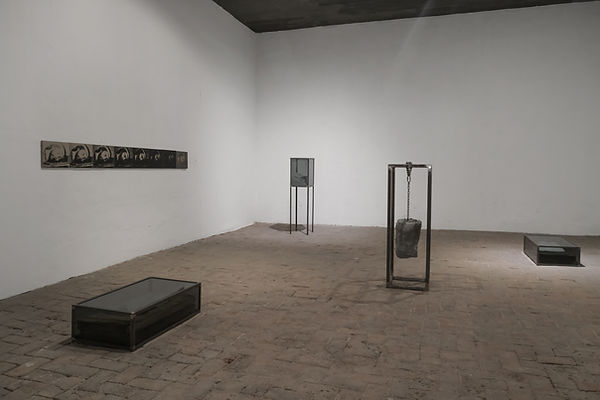
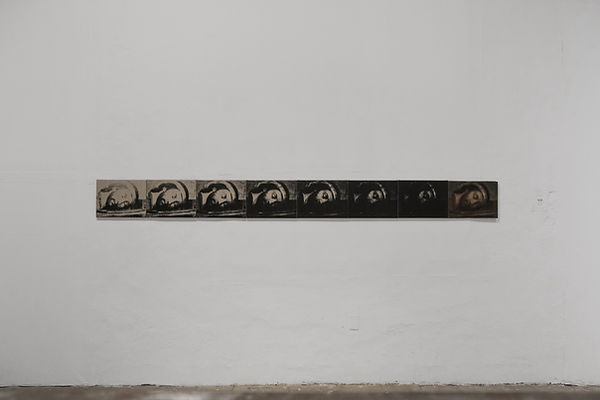
THRENI is Gabriel O’Shea’s first institutional museum exhibition, presented at the Museo de la Ciudad de Querétaro. The exhibition brings together recent works and new productions conceived specifically for the show, spanning painting, sculpture, and installation. Across different materials, scales, and formats, THRENI includes small oil portraits, large-format paintings, works in wax and concrete, and pieces incorporating original eighteenth- and nineteenth-century sacred paintings. The exhibition continues O’Shea’s ongoing investigation into mourning, spiritual ruin, memory, and the persistence of the sacred within a contemporary technological landscape. In ¨THRENI¨, each material carries the weight of its own history. Concrete mineralizes, wax retains the memory of touch, metal oxidizes, and organic matter decomposes — registering time rather than resisting it. The body that appears across these works is rarely whole: it arrives as torso, fragment, or cast, traversed by nails or enclosed within steel structures that function simultaneously as frames and cages. Religious iconography, fragmented bodies, industrial materials, liturgical references, and contemporary technologies coexist within a territory of tension — traversed by the suspicion that the human need for transcendence, consolation, and revelation has migrated toward new altars: the screen, the algorithm, the image in permanent circulation. THRENI continues a sequence of musical titles that has marked the recent development of O’Shea’s work. Following ¨PRELUDIO¨ (Galería Hilario Galguera, Mexico City, 2023) and ¨OBERTURA¨ (Galería Hilario Galguera, Madrid, 2025), the sequence now arrives at the *threnos* — the funeral chant, the lament, the voice that remains after collapse. The title also refers to ¨Threni¨, Igor Stravinsky’s composition based on the ¨Lamentations of Jeremiah¨. If a prelude opens and an overture introduces, a threnos emerges when what once sustained the world has begun to crumble. THRENI does not propose a nostalgic farewell, but a lucid lamentation. As Castro Flórez writes: “After total ruin, what remains is to understand what is left over and what is missing. Consumatum est.” "O'Shea has used wax, for years, to rematerialize fragments of bodies — alluding, without anecdote or documentary derivations, to contextual violence. Perhaps these 'disciplines' of the flesh are linked to his religious upbringing, which introduces a trace of enigmatic spirituality. His capital visions do not share the dynamics of technological futurism, even if they have a singular cyber-gothic tone. Ultimately, these pictorial machinations are efforts — despite everything — to recompose the human in an era of nihilism consummated in the form of cybernetics." Excerpt from: ¨ENCARNACIONES INQUIETANTES / The Unsettling Incarnations of Gabriel O’Shea¨ by Fernando Castro Flórez